
Prime Minister says India’s investments in clean energy over the past decade have strengthened its ability to withstand global disruptions, including the ongoing West Asia crisis; highlights renewable energy as a key pillar of the country’s development journey.
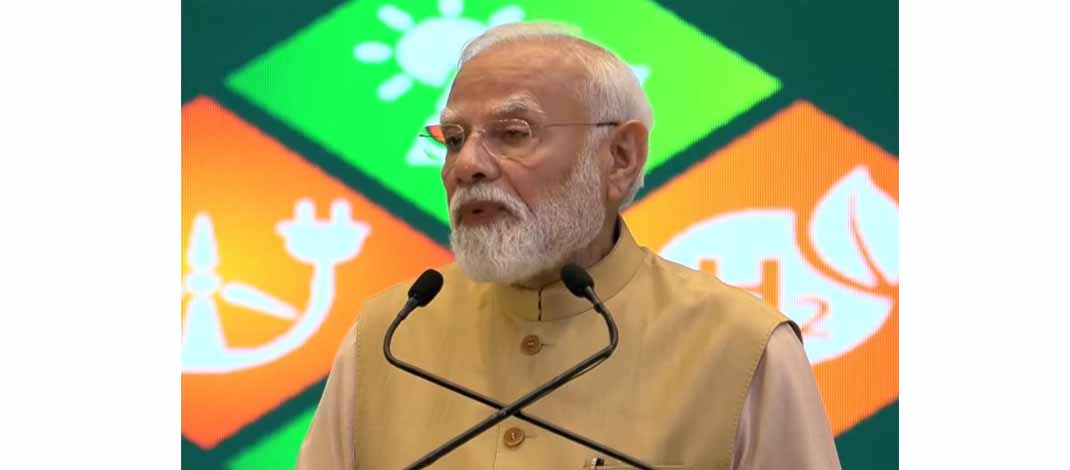
New Delhi : Prime Minister Narendra Modi inaugurated the Bharat Renewable Energy Summit & Expo in New Delhi, underlining the growing importance of renewable energy in ensuring India’s energy security, economic stability and long-term development. Addressing the gathering, the Prime Minister said the summit was particularly significant this year as it was taking place at a time when the world was witnessing widespread discussions on an emerging energy shock. He observed that recent global developments had brought the importance of renewable energy into sharper focus, both in people’s lives and in the country’s development journey.
PM Modi also pointed out that it was a happy coincidence that the 9th Assembly of the International Solar Alliance (ISA) was being held alongside the summit, reflecting the growing international focus on solar energy and clean energy cooperation.
Referring to the series of unprecedented challenges faced by the global economy over the past few years, the Prime Minister mentioned the COVID-19 pandemic and the ongoing crisis in West Asia. He said the world had been compelled to navigate one major disruption after another, while the West Asia situation continued to remain a concern.
The Prime Minister expressed pride in the resilience demonstrated by India’s 140 crore people, stating that the country had managed these difficult circumstances relatively well so far. He also highlighted that India had maintained a strong growth trajectory despite the challenging international environment.
Emphasising the role of India’s clean energy investments, PM Modi said that the country’s efforts over the past decade to expand renewable energy capacity and develop new energy systems had helped strengthen its ability to manage external shocks. Had India not made these investments and built the necessary systems, the impact of the global crises on its economy could have been considerably more severe.
“Energy security is directly linked to economic security,” the Prime Minister said, describing this as one of the key lessons emerging from the current global situation.
His remarks highlighted the strategic importance of diversifying energy sources, reducing vulnerability to international disruptions and strengthening domestic energy capabilities. The expansion of renewable energy, particularly solar and other clean energy technologies, is increasingly central to India’s efforts to build a resilient and sustainable energy ecosystem.
The summit and the parallel meeting of the International Solar Alliance are expected to provide a platform for policymakers, industry representatives, technology developers and international stakeholders to deliberate on renewable energy deployment, investment opportunities and cooperation in the clean energy sector.
The Prime Minister’s message underlined that India’s clean energy transition is not merely an environmental priority but also an important component of its economic resilience, energy independence and long-term national development.
Prime Minister Narendra Modi highlighted India’s progress in the renewable energy sector over the past 12 years, describing the country’s journey as one driven by promises, passion and performance. He said India’s commitment to clean energy, reflected in its pledges at international climate forums, demonstrated its determination to move towards a sustainable energy future.
Recalling India’s commitments made at the COP26 Summit in 2021, the Prime Minister said the country had set an ambitious target of achieving 500 GW of non-fossil fuel energy capacity by 2030. He emphasised that India had made this commitment with a clear resolve to fulfil it.
PM Modi also referred to India’s pledge under the Paris Agreement to meet 50 per cent of its installed electricity capacity through non-fossil fuel sources. He stated that India had achieved this milestone in 2025, five years ahead of the 2030 deadline.
According to the Prime Minister, more than 50 per cent of India’s total installed power capacity now comes from non-fossil fuel sources, marking a significant milestone in the country’s energy transition.
The achievement reflects India’s expanding focus on renewable energy and other non-fossil fuel sources, including solar, wind, hydro and nuclear power. It also highlights the country’s efforts to diversify its energy mix, strengthen domestic energy capabilities and reduce dependence on conventional fossil fuels.
The Prime Minister reiterated that India remains committed to its 2030 target of 500 GW of non-fossil fuel energy capacity, underlining that the country’s clean energy ambitions are being pursued through sustained policy efforts, infrastructure development and investment.
India’s early achievement of the 50 per cent installed-capacity milestone marks an important step in its clean energy transition, while the 500 GW target remains a key benchmark for the country’s renewable energy journey.
